
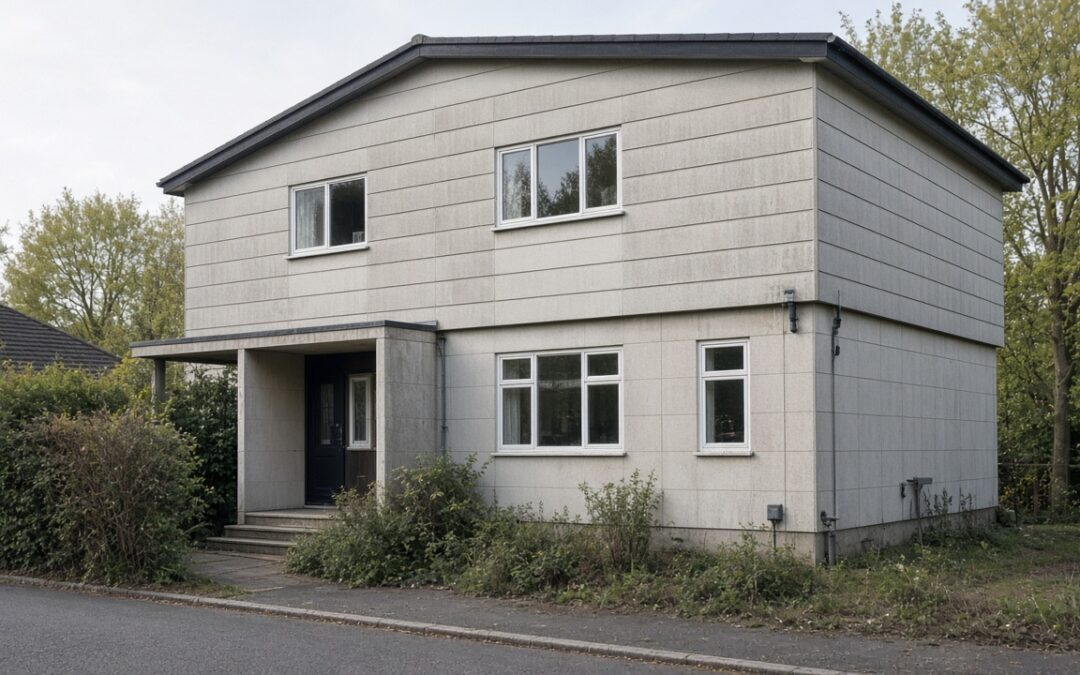
Non-traditional and designated defective properties remain a substantial part of the UK’s housing story. Owners, housing providers and lenders still need clear, construction-aware surveying advice — especially where standard mortgage valuation practice alone does not answer questions about system type, structural form or remediation history.
LKD Surveying & Consulting provides chartered building surveying and chartered building engineering on non-traditional and defective stock. This article outlines what “non-traditional” and “designated defective” usually mean in practice, what owners and lenders typically need to know, and how specialist surveying support fits with our wider services.
What “non-traditional” usually means
In housing and lending conversations, “non-traditional” generally points to dwellings built with systems other than conventional brick-and-block or timber-frame methods that valuers treat as routine. That can include precast reinforced concrete (PRC) houses, steel-framed systems, large-panel concrete, and a range of post-war and mid-century methods that vary by region and manufacturer.
The label is descriptive, not automatically pejorative. Many non-traditional homes have been well maintained, thoughtfully repaired or formally remediated. Others still carry unresolved defects, incomplete paperwork or uncertainty about the original system. The surveying task is to identify the construction, assess condition and risk in context, and report in language owners and lenders can use.
Designated defective stock
Some construction types were designated defective under historic UK housing legislation and related schemes. Designation does not mean every dwelling of that type is unsafe or unsaleable; it does mean lenders, insurers and purchasers often ask for more evidence than they would for a standard traditional house. Typical questions include: has a recognised repair scheme been completed; is there certification or warranty documentation; what is the current structural condition; and how does the dwelling compare with unrepaired examples of the same type?
Owners sometimes discover designation issues only when they try to remortgage or sell. Early specialist advice can reduce last-minute surprises. Our non-traditional and defective property work is designed for exactly these briefs.
What owners typically need
Owner-occupiers and private landlords usually need a clear identification of construction type, a condition assessment of key structural and weatherproofing elements, and an honest view of whether further investigation, repair or certification support is warranted. They also need reports that avoid unnecessary alarm while not glossing over material defects.
Where works have already been done, owners benefit from relating those works to known repair schemes and available paperwork. Where works have not been done, a staged view — what is urgent for weatherproofing and safety of fabric, what is desirable for mortgageability, and what is optional improvement — is more useful than a single undifferentiated list.
What lenders and advisers typically need
Lenders and their advisers look for construction clarity, condition relative to type, and evidence that any required remediation has been completed to an identifiable standard. They may also ask whether the property is suitable for the product being considered. Specialist surveying input supports that conversation; it does not replace the lender’s own credit and policy decisions.
Where certification history is incomplete, retrospective certification support can help assemble technical evidence for older or non-traditional stock. For purchase or remortgage pathways, see also our note on mortgage support surveying.
How specialist surveying helps
Specialist input matters because system identification is not always obvious from a kerbside glance, and because defect patterns differ by construction type. A surveyor who routinely works with non-traditional stock is more likely to know which details to inspect, which documents to request, and how to phrase findings for housing providers and lenders without inventing certainty the evidence does not support.
LKDSC works UK-wide. We do not offer fire-safety assessments or fire-engineered design; our high-rise residential work is structural and condition-focused, described separately under high-rise residential surveying. For background on the practice, see About LKDSC.
Practical next steps
- Gather any historic surveys, repair certificates, warranties and planning or building-control records you already hold.
- Note known construction type labels from purchase packs or landlord asset data — and treat them as starting points, not final answers.
- Decide whether the immediate need is condition advice for an owner, a lender-facing report, or portfolio-level screening.
If you own, manage or are advising on non-traditional or designated defective property and need a clear surveying brief, email tom@lkdsc.co.uk or reach us via the contact page. Include location, property type if known, and whether the driver is ownership, lending or stock planning.