
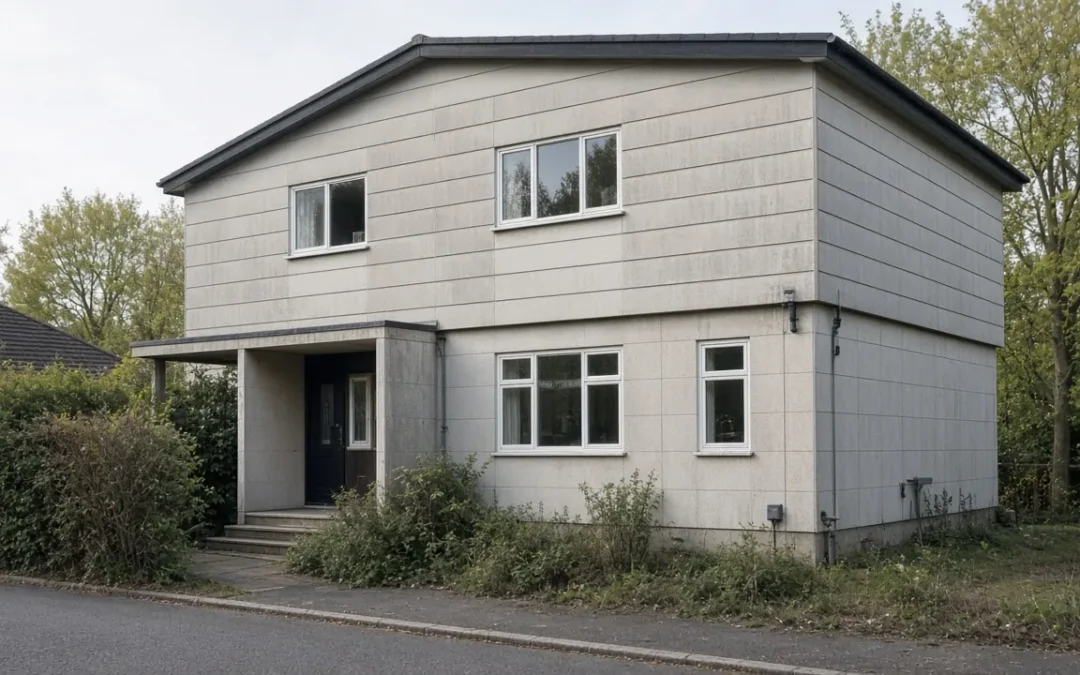
A single non-traditional house can be surveyed as a one-off: confirm the system, look at the fabric, review any repair history, and set out clear next steps for the owner, the lender or the adviser. An estate of the same construction is a different brief. The dwellings may share a system, a repair era and a set of typical defects, but they will not all be in the same condition, and they will not all have the same paperwork. Treating the estate as if it were one large house, or as if it were a collection of unrelated addresses, both lead to poor decisions.
LKD Surveying & Consulting’s non-traditional and designated defective work covers assessment, repair considerations and advice on next steps for repaired and unrepaired stock, from a single dwelling to a wider estate. This article is for housing associations, local authorities, managing agents and their advisers who need to instruct that estate-scale work. It sits alongside our introduction to what owners and lenders need to know about non-traditional and designated defective properties, which starts from the individual dwelling.
What “designated defective” actually means
Not every non-traditional house is a designated defective dwelling, and not every designated defective dwelling is still unrepaired. In England and Wales, Part XVI of the Housing Act 1985 allows the Secretary of State to designate a class of buildings as defective where they appear defective by reason of their design or construction, and where, because that has become generally known, the value of some or all of the dwellings has been substantially reduced. Local housing authorities have a similar power, under section 559, to designate classes in their own district. A designation describes the qualifying defect, sets a cut-off date, and specifies a period within which eligible owners may apply for assistance under the Act (reinstatement grant or repurchase). That period can be extended, even after it has expired.
The designations themselves were made as a series of named classes, many of them prefabricated reinforced concrete (PRC) types. Official instruments such as the Housing Defects (Expenditure Limits) Order 1992 list those classes by their designation titles — for example Airey, Cornish Unit, Wates, Unity and Butterley, Tarran, Dorran, Boswell, Stent and others. The list is a matter of record, not a menu of every non-traditional system still in use. Plenty of system-built and non-traditional homes were never designated, and they still need construction-aware surveying. Confirmation of whether a particular house or block falls within a designated class is a factual question. Under the Act, questions of that kind are for the Secretary of State to determine if the class was designated under section 528, and for the local housing authority if it was designated under a local scheme.
For an estate, the useful starting point is therefore a reliable schedule: which addresses are which system, which (if any) fall within a designated class, which have already been repaired, and what evidence exists for those repairs. Guesswork from a small sample of front elevations is not enough, especially where later cladding, extensions or partial repair schemes have changed how the dwellings look from the street.
Why an estate cannot be judged from one plot
System-built estates were often constructed in runs, but they have not aged as a single object. One house may have a documented licensed repair; the next may have had informal works, or no works at all. Exposure, alterations, drainage, and the quality of past maintenance all vary. A report that says “the estate is a Wates type and therefore needs X” without inspecting a sufficient, well-chosen set of dwellings, and without separating observed condition from assumed condition, will not stand up when a board, a funder or a purchaser asks for the evidence.
At the same time, inspecting every dwelling to the same depth as a one-off mortgage or certification case is not always the first instruction, and it is not always the right one. Estate-scale work is usually about producing a consistent picture that asset managers can use: construction type confirmed, typical defects and variations recorded, repaired and unrepaired groups distinguished, and a clear split between what has been seen, what has been inferred from the system, and what needs a closer look. That picture can then support a stock condition programme, a repair strategy, or, where works have already been carried out, retrospective certification.
The brief should also say how findings will be used. An investment plan, a planned repair programme with a builder, a refinancing pack, or advice to individual right-to-buy or leasehold owners are different outputs. Our note on builder repairs for designated defective and non-traditional homes covers the surveying support that sits around repair packages. If the estate-scale report is meant to lead into that work, say so at the start, so the inspection records the things a contractor and a later certifier will actually need.
What a useful estate brief usually contains
- A complete address list, with tenure, and any existing construction-type or “PRC / designated defective” flags, however incomplete they may be.
- Repair history: schemes, dates, specifications, certificates, guarantees, and whether works were to a recognised or licensed method, where that is known.
- The decision the report must support — stock planning, repair scoping, lending or disposal evidence, or a mix — and the level of inspection that decision justifies.
- How dwellings will be selected if the first phase is not a 100 per cent internal inspection: archetypes, repaired versus unrepaired groups, end-of-terrace and mid-terrace plots, and any homes already flagged for defects or complaints.
- Access arrangements, including how no-access houses will be recorded and revisited, and how findings will be shared with residents in plain language.
- Where the estate-scale work should stop and a more detailed inspection, a repair brief, or certification support should begin.
Limits that should be written into the report
An estate survey cannot certify dwellings that were not inspected, and it cannot invent a repair history that the documents do not support. It also cannot give mortgage advice. LKDSC can advise owners and, where relevant, put them in touch with contacts experienced with lending on non-traditional stock; we do not provide mortgage advice ourselves. Reports should say clearly when a conclusion is based on a sample, when a system type is confirmed or only provisional, and when further opening-up, structural investigation or specialist testing would be needed before a stronger statement is made.
Used carefully, estate-scale surveying gives housing providers a consistent account of stock that standard generic surveys often miss. It does not replace a dwelling-by-dwelling inspection where a sale, a loan or a certification decision needs one, and it does not replace a properly specified repair package. If you would like to discuss a non-traditional or designated defective estate, email tom@lkdsc.co.uk or use our contact page with the location type, the approximate number of dwellings, and what you already know about the construction and any past repairs.